
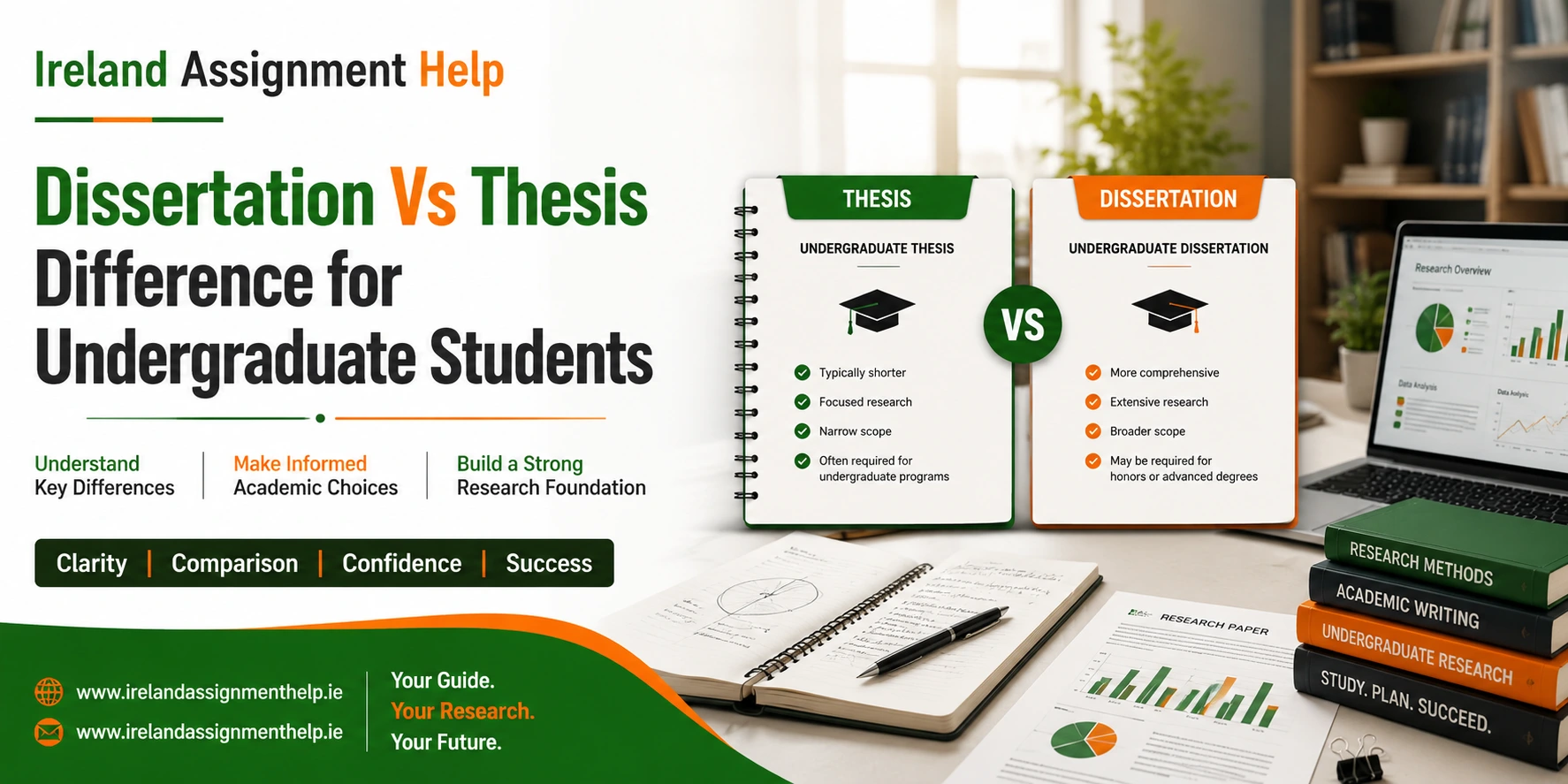
Dissertation Vs Thesis Difference for Undergraduate Students
Academic writing is like a journey where students slowly build their research skills. At the end of this journey, students need to represent their ideas in a big project. Somewhere it is called a thesis, and some call it a dissertation. Both names and purpose sound similar, but understanding each can make a difference. In this blog, you will understand the clear difference between a dissertation vs thesis, along with their clear definition, purpose, and structure.
Most students get confused just by hearing the name of a dissertation or thesis. Some of them think that they are both the same, but they are not. This is why understanding the differences between them is crucial for those who are planning for higher education. It will also help them to prepare better for academic writing.
What Is A Dissertation?
A dissertation is a long research project that is written by students at the end of a degree, especially a doctoral (PhD) degree. It is a new contribution to the insights, knowledge, and theories built on the work of others. It may be a time-consuming process to write a dissertation and take years to complete, which is why students seek dissertation writing help at this stage. What students need to do is:
- Study a topic
- Read research papers
- Gather data
- Analyze information
- Explain the result clearly
The length of a dissertation usually ranges from 100 to 300 pages. The purpose of writing a dissertation involves generating an original thought about the unresolved issues inherent in the subject discipline. It includes developing a test or model, collecting and analyzing data to generate a presentation, reporting the new original data, and providing support to complete the dissertation. The common structure of a dissertation should contain:
- Abstract
- Introduction
- Literature Review
- Research Methodology
- Results
- Discussion
- Conclusion
- References/Appendices
What Is A Thesis?
A thesis is usually written for a master’s or bachelor’s program and demonstrates the student’s understanding of that program. It is a summary of pre-existing research that applies analysis, interpretation, and synthesis to support and challenge a specific hypothesis (idea). Most of the theses are much longer, more detailed, and based on deep research. The thesis is usually 60-100 pages long.
The purpose of a thesis is to show the student’s understanding of theoretical literature, literature review, data analysis, and reasoned conclusion. Acknowledgements in Thesis & Dissertations also play a meaningful role in reflecting the support behind the work, although it does not always need original research, but reflects the understanding of the topic and methodology. The structure of a thesis usually contains:
- Introduction
- Literature Review
- Research Methodology
- Results
- Discussion
- Conclusion
Key Differences: Dissertation Vs Thesis
You have now understood the basics of a dissertation and thesis. Let’s discuss the details where these two research projects differ and study the dissertation vs thesis.
Level Of Study
A thesis is mostly designed for a master’s program that requires a focus on the analysis and interpretation of existing research within the field. The student’s role is to gather and examine all the information to provide fresh perspectives and insights. Students often rely on a thesis writing service to manage an extensive load.
A dissertation is carried out in a PhD program to create new knowledge from original research. It is beyond the master’s program, which requires a broader scope, a more lengthy, and deeper analysis and contribution to the field.
Research Expectations
A thesis involves the analysis of existing research, literature reviews, and the synthesis of established theories and findings. It does not need the original research, but the interpretation of existing work through a student’s perspective is important.
A dissertation needs to conduct original research, collecting and analyzing the data, and presenting insights to address gaps in existing knowledge for developing new frameworks, solutions, or models. It should be innovative and contribute to the field.
Scope Of Work
The scope of a thesis is narrow enough that it focuses on a single question or a topic. It analyzes a limited set of data and existing studies, along with summarizing prior studies. The methodology often uses established techniques and frameworks to address the research questions.
A dissertation is broader in scope and addresses complex research questions. It contains an extensive literature review to analyze existing research for identifying the gaps and justifying the study. The methodology is designed to implement original, rigorous research to address complex questions and contribute new knowledge.
Final Defense
A thesis defense lasts only for 1-2 hours, which includes a formal defense before a faculty panel for research understanding and findings.
A dissertation defense is a rigorous process that often lasts for 2-3 hours, where students need to defend and justify their findings, methodology, and contribution to the field.
Comparison Of Thesis And Dissertation
| Aspects | Thesis | Dissertation |
| Academic Level | Master’s Program | Doctoral Degree (PhD) |
| Purpose | It determines the understanding of the existing research. | It is the contribution of the original research. |
| Requirements | It might not include the original research. | It must include significant and original research. |
| Length | Short (60-100 pages) | Lengthy (150-300+ pages) |
| Contribution | It consolidates the knowledge. | It expands the field with new findings. |
| Evaluation | The faculty committee within the university. | It often includes the external academic examiner. |
Regional Differences
While different universities often have different requirements for the thesis and dissertation, there are some regional differences that you should understand.
- USA: In the US, the thesis needs to be done at the bachelor’s or master’s level, while a dissertation is a massive research project for the doctoral program (PhD).
- UK: The roles of both projects are reversed in the UK. A dissertation is completed in the final year of a master’s program, and a thesis is required for a PhD.
Is writing a dissertation harder than a thesis?
Both of them are hard in their own way. A thesis is a little harder because it requires interesting research, while a dissertation is just a writing about what we already know.
Which one is longer? A doctoral dissertation or a master’s thesis?
A doctoral dissertation is longer than a master’s or undergraduate thesis, as it requires more in-depth information on the existing literature.
Do undergraduate students write a dissertation or a thesis?
Writing whether a dissertation or a thesis as a final independent research project, it all depends on the university’s preferences and region.
Conclusion
A thesis and a dissertation are both valuable components of higher education that provide in-depth research experience to students. It is important to understand that, while these projects are similar, they differ in scope, expectations, and goals.
A dissertation is usually conducted in a PhD-level program to contribute new knowledge to the field. A thesis is involved in the academics of a master’s program, which is the research and study of existing knowledge. The expected work in the thesis is just the analysis of existing work and addressing a single question, but the dissertation needs to show original work and address many complex questions, which is why the thesis scope is narrow, and the dissertation is broader. Summary response essay concepts are sometimes introduced at earlier academic stages to help students build the analytical skills required for both.
A final defense of the thesis is short, around 1-2 hours, while a dissertation is lengthy, about 2-3 hours. There are also regional differences: in the USA, the thesis is done at the bachelor’s and master’s levels, and a dissertation at the PhD level, but in the UK it is reversed.

I help students, educators, and institutions communicate complex ideas through precise academic writing. With a strong focus on research quality and structure, my work is grounded in credible research, proper citations, and a strong understanding of academic formatting and guidelines.